

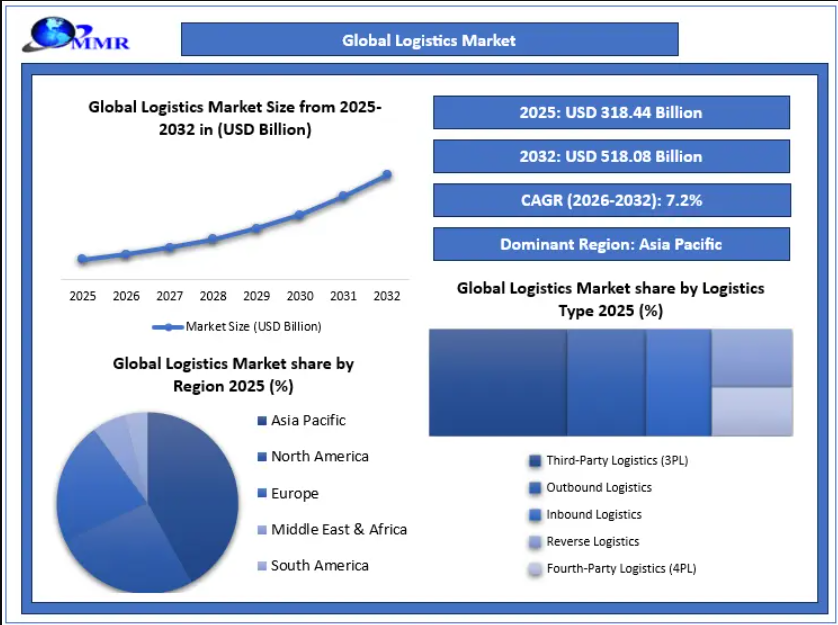
Global Logistics Market to Reach USD 518.08 Billion by 2032 Driven by E-Commerce Expansion and Smart Supply Chain Technologies
The global Logistics Market is projected to grow from USD 318.44 billion in 2025 to USD 518.08 billion by 2032, registering a CAGR of 7.2% during the forecast period. The market is witnessing strong momentum due to the rapid expansion of e-commerce, rising adoption of automation and IoT-enabled tracking systems, and increasing investments in AI-driven supply chain management solutions.
E-Commerce Boom Accelerating Logistics Demand Worldwide
The rapid growth of online shopping has emerged as one of the most significant drivers for the logistics industry. Global e-commerce sales increased from USD 4.98 trillion in 2021 to nearly USD 6.86 trillion in 2025, with projections surpassing USD 8 trillion by 2027.
The growing number of online consumers has created massive demand for:
- Last-mile delivery services
- Cross-border logistics
- Warehousing and fulfilment centers
- Third-party logistics (3PL)
- Real-time shipment tracking
- Smart transportation solutions
As digital commerce continues expanding globally, logistics companies are heavily investing in infrastructure modernization and advanced technologies to improve operational efficiency and delivery performance.
To know the most attractive segments, click here for a free sample of the report:https://www.maximizemarketresearch.com/request-sample/94795/
Consumer Demand for Faster Last-Mile Delivery Reshaping the Industry
Consumer expectations for same-day and next-day delivery are significantly transforming logistics operations across urban regions worldwide. Last-mile deliveries are expected to grow by nearly 78% globally by 2030, while delivery vehicle volumes may increase by 36% in major metropolitan areas.
To address rising delivery expectations, logistics providers are adopting:
- Micro-fulfilment centers
- Regional distribution hubs
- AI-based route optimization
- Automated sorting systems
- Electric delivery vehicles
- Smart fleet management platforms
These strategies are helping reduce average urban delivery times, which improved from 2.36 days in 2022 to 2.15 days in 2023.
Automation and Robotics Enhancing Warehouse Efficiency
Automation technologies are playing a vital role in improving warehouse productivity and operational scalability. Around 53% of logistics firms across OECD economies have already integrated robotics into warehouse operations.
Automated systems are helping logistics companies:
- Process high shipment volumes efficiently
- Reduce operational costs
- Improve inventory accuracy
- Enhance order fulfilment speed
- Minimize human error
High-volume logistics regions are now handling over 1.2 million shipments daily using advanced warehouse automation technologies.
IoT and AI Revolutionizing Supply Chain Management
The adoption of IoT-enabled tracking systems and AI-based supply chain analytics is rapidly reshaping the logistics ecosystem. Approximately 48% of advanced economy logistics firms currently use IoT tracking solutions for real-time cargo monitoring and predictive delivery management.
AI-driven technologies are helping companies:
- Optimize transportation routes
- Improve demand forecasting
- Enhance supply chain visibility
- Reduce fuel consumption
- Improve fleet utilization
- Enable predictive maintenance
In addition, nearly 67% of cross-border logistics operators have adopted digital documentation systems to streamline customs processes and improve shipment transparency.
Rising Transportation Costs Challenge Market Growth
Despite strong growth prospects, rising logistics and transportation costs remain a significant challenge for the industry. Increasing fuel prices, labor costs, warehousing expenses, and infrastructure bottlenecks are pressuring operational profitability across global supply chains.
In India, logistics expenditure accounted for approximately 7.97% of GDP in 2024, while freight transportation costs represented more than 80% of total logistics spending.
To overcome these challenges, companies are increasingly focusing on:
- Multimodal transportation optimization
- AI-powered logistics planning
- Automated warehousing
- Green logistics strategies
- Electric and low-emission delivery fleets
To know the most attractive segments, click here for a free sample of the report:https://www.maximizemarketresearch.com/request-sample/94795/
Asia-Pacific Dominates the Global Logistics Market
The Asia-Pacific region currently dominates the global logistics market due to strong e-commerce penetration, expanding industrial activity, and rapidly growing consumer demand.
Countries such as China, India, Japan, and Southeast Asian economies are leading logistics growth globally. China alone handles more than 900 million parcels annually, while India continues experiencing strong expansion in e-commerce logistics and last-mile delivery services.
Asia-Pacific also leads in digital logistics adoption, warehouse automation, and smart transportation infrastructure development.
E-Commerce Logistics Segment Witnessing Significant Growth
The e-commerce logistics segment is expected to witness substantial growth during the forecast period as retailers and logistics providers continue investing in faster and more reliable fulfilment capabilities.
Growing adoption of:
- Cloud-based logistics platforms
- Digital freight management
- Automated inventory systems
- Reverse logistics solutions
- Smart delivery technologies
is helping improve customer satisfaction and operational agility across the logistics ecosystem.
Competitive Landscape Remains Highly Dynamic
The global logistics industry remains highly competitive with major international players expanding investments in automation, AI, sustainability, and digital transformation.
Leading companies are increasingly focusing on:
- Cross-border logistics capabilities
- Green transportation solutions
- Smart warehouse technologies
- Real-time shipment visibility
- Cold chain logistics expansion
- Strategic regional partnerships
For example, DHL Group recently opened an advanced innovation center in Europe focused on AI, robotics, and sustainability initiatives. Meanwhile, Kuehne + Nagel launched a new air logistics gateway in Bengaluru to strengthen cross-border logistics operations in India.
Key Companies Operating in the Global Logistics Market
Major players operating in the global logistics market include:
- DHL Group
- Kuehne + Nagel
- DSV A/S
- DB Schenker
- CEVA Logistics
- A.P. Moller – Maersk
- UPS Supply Chain Solutions
- Sinotrans Limited
- GXO Logistics
- Delhivery
- Blue Dart Express
- Mahindra Logistics
- Americold Logistics
Future Outlook
The future of the global logistics market remains highly promising as businesses continue embracing digital transformation, automation, and smart supply chain technologies. Rising e-commerce penetration, increasing cross-border trade, and growing demand for fast, transparent, and sustainable delivery services are expected to create substantial growth opportunities through 2032.
As logistics providers continue investing in AI, IoT, robotics, and green transportation solutions, the industry is expected to evolve into a more intelligent, efficient, and environmentally sustainable global ecosystem.