

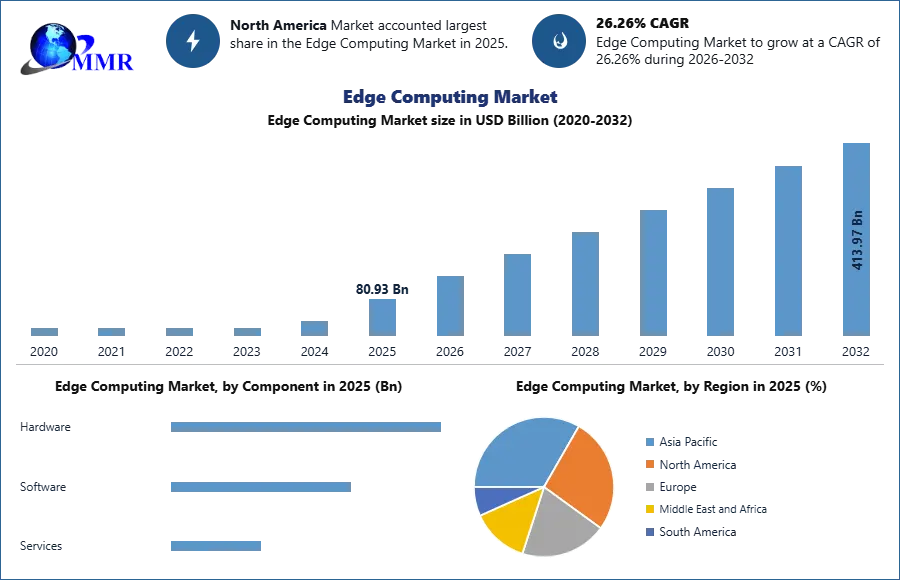
The digital economy is entering a new phase where speed, efficiency, and real-time intelligence are critical. The Edge Computing Market, valued at USD 80.93 billion in 2025, is projected to surge to USD 413.97 billion by 2032, growing at an impressive CAGR of 26.26%. As enterprises shift toward decentralized data processing, edge computing is rapidly becoming a cornerstone of modern IT infrastructure.
What is Edge Computing?
Edge computing is a distributed computing model that processes data closer to its source—such as IoT devices, sensors, or local servers—rather than relying solely on centralized cloud systems. This approach reduces latency, enhances performance, and enables real-time decision-making.
By bringing computation to the “edge” of the network, organizations can improve operational efficiency, reduce bandwidth costs, and unlock new use cases across industries.
Get A Free Sample Report Now:https://www.maximizemarketresearch.com/request-sample/3405/
Key Growth Drivers
Explosion of IoT Across Industries
The rapid adoption of IoT devices is one of the biggest drivers of edge computing. Industries such as manufacturing, healthcare, and transportation rely on real-time data from sensors and connected devices, making edge processing essential.
Need for Low-Latency Data Processing
Applications like autonomous vehicles, smart cities, and industrial automation require near-instant data processing. Edge computing enables faster decision-making by eliminating delays associated with cloud-only architectures.
Rise of AI and Real-Time Analytics
Edge computing supports AI workloads by enabling on-device processing and analytics. This is critical for applications that require immediate insights, such as predictive maintenance and video analytics.
Growth of 5G Networks
The rollout of 5G is accelerating edge adoption by enabling faster data transmission and supporting distributed computing architectures.
Market Trends Shaping the Future
Edge AI Integration
The convergence of AI and edge computing is enabling smarter, more autonomous systems. Organizations are deploying AI models directly at the edge for faster insights and improved privacy.
Hybrid Edge-Cloud Architectures
Businesses are increasingly adopting hybrid models that combine edge computing with cloud infrastructure for scalability and flexibility.
Micro Data Centers Expansion
The rise of localized data centers is supporting edge deployments, allowing organizations to process data closer to end users.
Industry-Specific Edge Solutions
Customized edge solutions are emerging across sectors such as healthcare, retail, and manufacturing, driving broader adoption.
Segment Insights
Hardware Dominates the Market
The hardware segment holds the largest share of the edge computing market. This includes:
- Edge servers
- Gateways
- Sensors
- Micro data centers
These components form the foundation of edge infrastructure, enabling real-time data processing and supporting advanced applications like Industrial IoT and AI inference.
Cloud and On-Premise Deployments
Organizations are adopting both cloud-based and on-premise edge solutions, depending on their specific needs for scalability, security, and latency.
Get A Free Sample Report Now:https://www.maximizemarketresearch.com/request-sample/3405/
Regional Analysis
North America Leads the Market
North America dominates the edge computing market due to:
- Advanced digital infrastructure
- High adoption of cloud and AI technologies
- Strong presence of leading tech companies
- Significant investments in 5G and IoT
The United States remains the primary growth engine, driving innovation and large-scale deployments.
Asia-Pacific Emerging as High-Growth Region
Countries like China, India, and Japan are rapidly adopting edge technologies, fueled by smart city initiatives, industrial automation, and expanding telecom infrastructure.
Competitive Landscape
The edge computing market is highly competitive, with major technology companies driving innovation and expansion. Key players include:
- Amazon Web Services
- Microsoft
- Cisco Systems
- IBM
- Intel
- NVIDIA
- Dell Technologies
- Hewlett Packard Enterprise
- Oracle
These companies are investing heavily in AI, cloud-edge integration, and partnerships to strengthen their market positions.
Recent Industry Developments
- In February 2025, Qualcomm Technologies and IBM expanded their collaboration to scale generative AI from edge to cloud.
- In January 2025, Verizon Business launched AI Connect, enabling low-latency edge computing for AI workloads in partnership with major cloud and AI providers.
These developments highlight the growing convergence of AI, edge computing, and cloud technologies.
Challenges in the Edge Computing Market
Despite its rapid growth, the market faces several challenges:
- High initial capital expenditure (CAPEX)
- Security and data privacy concerns
- Complexity of managing distributed infrastructure
- Integration with existing IT systems
Overcoming these challenges will be critical for widespread adoption.
Future Outlook
The future of edge computing is extremely promising. As digital transformation accelerates, edge computing will play a crucial role in enabling:
- Smart cities and connected infrastructure
- Autonomous systems and robotics
- Advanced healthcare solutions
- Real-time industrial automation
With continued advancements in AI, IoT, and 5G, the edge computing market is set to become one of the fastest-growing segments in the technology landscape.
Conclusion
The Edge Computing Market is experiencing explosive growth, driven by the need for real-time data processing, AI integration, and distributed computing. As organizations continue to adopt edge technologies, the market will unlock new opportunities across industries and redefine how data is processed and utilized.
For businesses and investors, edge computing represents a transformative opportunity to stay ahead in an increasingly connected and data-driven world.

