

Directed Energy Weapons Market Set to Surge as Global Defense Forces Accelerate Next-Generation Warfare Capabilities
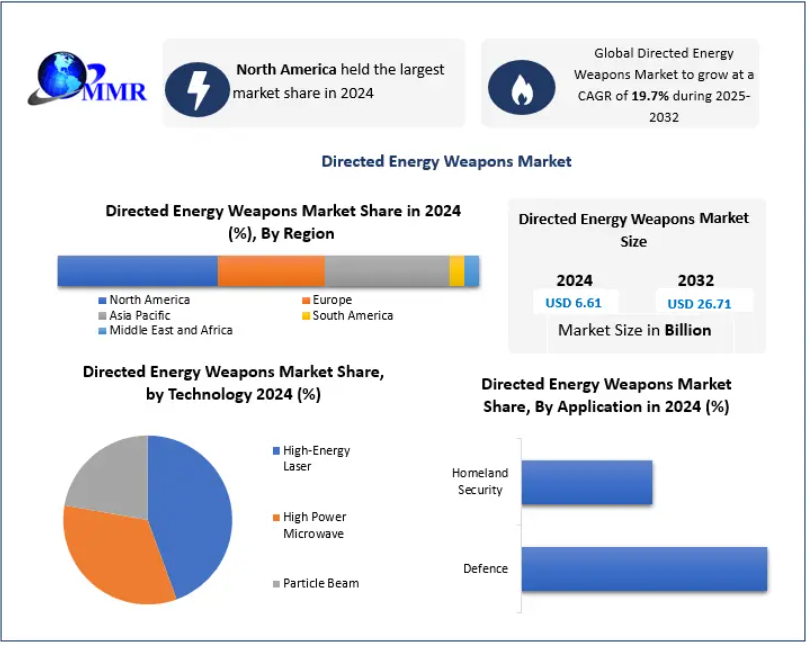
The global Directed Energy Weapons Market is entering a transformative growth phase as military organizations worldwide intensify investments in futuristic defense technologies capable of reshaping modern combat operations. Valued at USD 6.61 billion in 2024, the market is projected to reach nearly USD 26.71 billion by 2032, expanding at an impressive CAGR of 19.7% during the forecast period from 2025 to 2032.
Directed Energy Weapons (DEWs) are advanced defense systems that utilize concentrated electromagnetic energy—including high-energy lasers, high-power microwaves, and particle beams—to disable, damage, or destroy enemy targets. Unlike conventional kinetic weapons that rely on physical ammunition, DEWs offer precision targeting, rapid response capability, minimal collateral damage, and significantly lower operational costs per engagement.
To know about the Research Methodology :-https://www.maximizemarketresearch.com/request-sample/23344/
Rising Geopolitical Tensions Fuel Demand for Advanced Defense Technologies
Increasing geopolitical instability, border conflicts, and evolving asymmetric warfare threats are driving governments to modernize military infrastructures with next-generation defense systems. Nations are rapidly investing in DEWs to strengthen missile defense systems, neutralize drones, and protect critical infrastructure against emerging airborne threats.
The growing use of unmanned aerial vehicles (UAVs), hypersonic missiles, and electronic warfare systems has accelerated the demand for cost-effective and rapid-response defense solutions. Directed energy systems provide military forces with continuous engagement capabilities, making them highly effective against swarm drone attacks and high-speed projectiles.
Countries including the United States, China, India, Israel, and Russia are significantly expanding their investments in laser-based combat systems and microwave weapons to gain strategic military superiority.
High-Energy Laser Segment Dominates the Global Market
Based on technology, the High-Energy Laser (HEL) segment accounted for the largest share of the Directed Energy Weapons Market in 2024. High-energy laser systems are gaining widespread military adoption due to their superior targeting precision, operational reliability, and scalability across multiple combat platforms.
HEL systems are increasingly deployed for:
- Counter-drone operations
- Missile interception
- Air defense missions
- Naval ship protection
- Counter-rocket, artillery, and mortar (C-RAM) operations
One of the major advantages of HEL systems is their low cost per shot compared to traditional missile-based defense systems. Once operational, laser weapons can fire repeatedly without requiring expensive ammunition reloads, making them economically attractive for defense agencies worldwide.
Defense contractors are continuously improving laser beam quality, power generation efficiency, and thermal management systems to enable longer-range engagements and enhanced battlefield performance.
Defense Sector Emerges as Largest Application Area
The defense application segment continues to dominate the market as armed forces worldwide adopt DEWs for modern combat scenarios. Military organizations increasingly prefer directed energy systems due to their:
- Precision strike capability
- Rapid target engagement
- Reduced collateral damage
- Lower operational costs
- Ability to counter advanced aerial threats
Defense agencies are integrating DEWs into land-based combat vehicles, naval destroyers, airborne platforms, and space-based systems. These weapons are becoming critical components of layered defense architectures aimed at neutralizing drones, cruise missiles, rockets, and electronic threats.
Modern warfare environments demand highly agile and scalable solutions, further boosting the adoption of directed energy technologies across global military programs.
Counter-Drone Warfare Creates Massive Growth Opportunities
The rapid rise of drone warfare has emerged as one of the biggest catalysts for the Directed Energy Weapons Market. Military and homeland security agencies are actively seeking effective anti-drone systems capable of neutralizing UAV swarms with speed and precision.
Directed energy systems offer a major advantage over traditional air-defense systems because they can:
- Engage multiple drone targets rapidly
- Minimize ammunition dependency
- Reduce interception costs
- Operate with near-instantaneous response times
The deployment of advanced anti-drone laser systems by the United States Army and Israeli Defense Forces highlights the growing strategic importance of DEWs in counter-UAV operations.
To know about the Research Methodology :-https://www.maximizemarketresearch.com/request-sample/23344/
Naval and Maritime Security Applications Expand Rapidly
Naval forces worldwide are increasingly integrating directed energy systems into warships to strengthen maritime defense capabilities. Modern naval laser systems can effectively counter:
- Hostile drones
- Fast attack boats
- Missile threats
- Surveillance systems
The United States Navy has already deployed advanced laser weapon systems aboard naval vessels to enhance fleet protection while reducing operational costs associated with missile interceptors.
Sea-based DEWs provide significant advantages in maritime operations because naval platforms can support large onboard power generation systems required for high-energy laser weapons.
Space Defense and Homeland Security Open New Market Frontiers
As the militarization of space accelerates, directed energy systems are increasingly being explored for satellite protection, anti-satellite defense, and space situational awareness missions.
Governments are also deploying DEWs for homeland security operations including:
- Border surveillance
- Perimeter defense
- Crowd control
- Critical infrastructure protection
Non-lethal directed energy technologies such as microwave systems and active denial systems are gaining traction among law enforcement and security agencies for controlled engagement scenarios.
Technological Advancements Drive Innovation Across the Industry
Continuous breakthroughs in:
- Solid-state laser technology
- Beam control systems
- Thermal management
- Energy storage
- Artificial intelligence integration
are significantly enhancing the effectiveness and deployment flexibility of DEWs.
Defense manufacturers are increasingly focusing on compact and mobile laser systems capable of integration into armored vehicles, fighter aircraft, and autonomous defense platforms.
Recent innovations in hybrid-electric power systems and beam stabilization technologies are enabling more efficient long-range targeting and higher battlefield survivability.
High Development Costs Remain Key Market Challenge
Despite strong growth potential, the Directed Energy Weapons Market faces several operational and technological challenges. The development and deployment of advanced DEW systems require massive investments in research, testing, and infrastructure.
Additional market restraints include:
- High power consumption requirements
- Atmospheric interference affecting laser performance
- Platform integration complexities
- Size and weight limitations
- Countermeasure development by adversaries
Environmental conditions such as rain, fog, dust, and smoke can reduce laser beam effectiveness, especially in long-range combat scenarios.
Moreover, ethical concerns and regulatory uncertainties regarding the use of advanced energy-based weapons continue to influence public and political acceptance.
North America Leads the Global Directed Energy Weapons Market
North America dominates the global market due to strong defense spending, technological leadership, and extensive military modernization initiatives led by the United States.
Major defense contractors headquartered in the region are heavily investing in next-generation directed energy programs to support evolving combat requirements.
Meanwhile, Asia-Pacific is expected to witness the fastest growth during the forecast period due to rising regional tensions, increasing defense budgets, and rapid military modernization programs in China, India, South Korea, and Japan.
Competitive Landscape Intensifies Among Defense Giants
Leading companies operating in the Directed Energy Weapons Market are aggressively expanding research partnerships, government contracts, and technology development initiatives to strengthen their competitive positions.
Key market participants include:
Lockheed Martin Corporation
Northrop Grumman Corporation
RTX Corporation (Raytheon Technologies)
The Boeing Company
L3Harris Technologies
BAE Systems plc
Thales Group
Rheinmetall AG
Leonardo S.p.A.
Israel Aerospace Industries Ltd.
In October 2023, Lockheed Martin Corporation secured a major contract to develop and supply 300 kW-class laser weapon systems for the U.S. Army’s Indirect Fire Protection Capability-High Energy Laser (IFPC-HEL) prototype initiative, reinforcing the growing commercialization and military adoption of advanced laser-based defense systems.
Future Outlook
The future of the Directed Energy Weapons Market appears highly promising as nations continue prioritizing advanced defense modernization programs and next-generation combat technologies. With increasing demand for precision-based, low-cost, and rapid-response weapon systems, DEWs are expected to become integral components of future military operations across land, sea, air, and space domains.
As technological innovation accelerates and operational capabilities improve, directed energy systems are poised to redefine the future of warfare and global defense strategies over the next decade.

