

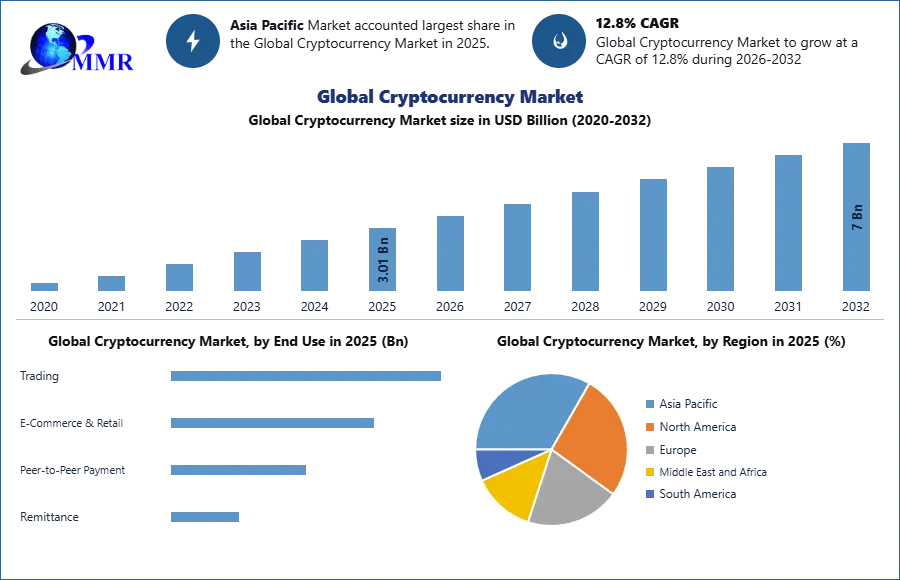
The Cryptocurrency Market is witnessing rapid expansion, with its size valued at USD 3.01 billion in 2025 and projected to reach nearly USD 7 billion by 2032, growing at a robust CAGR of 12.8%. The surge is fueled by the rise of decentralized finance (DeFi), increasing institutional participation, and growing adoption of blockchain technology across industries.
What is Driving the Cryptocurrency Market?
Cryptocurrency, powered by blockchain technology, has evolved from a niche innovation into a global financial phenomenon. Digital currencies operate on decentralized networks, offering enhanced security, transparency, and reduced reliance on traditional financial intermediaries.
The increasing demand for faster, low-cost, and borderless transactions is significantly boosting the adoption of cryptocurrencies worldwide.
To know about the Research Methodology :-https://www.maximizemarketresearch.com/request-sample/221768/
DeFi Revolution Transforming Financial Services
One of the strongest growth drivers is the rise of decentralized finance (DeFi), which enables users to access financial services like lending, borrowing, and trading without banks.
Platforms built on blockchain networks such as Ethereum and Solana are revolutionizing how financial systems operate, offering higher efficiency and accessibility.
This shift is attracting both retail and institutional investors, accelerating the growth of the cryptocurrency ecosystem.
Bitcoin Dominance and Digital Scarcity
Bitcoin continues to dominate the market, largely due to its limited supply and strong perception as “digital gold.” With a capped supply and periodic halving events, Bitcoin creates scarcity that influences its value and investor sentiment.
Other cryptocurrencies like Cardano and Dogecoin are also gaining traction, contributing to market diversification.
Growing Use in Payments and Remittances
Cryptocurrencies are increasingly being used for:
- Cross-border payments
- Peer-to-peer transactions
- E-commerce payments
Their ability to reduce transaction fees and processing times makes them particularly attractive for international remittances and global trade.
Key Market Challenges
Despite strong growth, the cryptocurrency market faces several hurdles:
- Regulatory uncertainty across different countries
- Security risks such as hacking and fraud
- Scalability limitations in blockchain networks
- Lack of widespread understanding among users
Governments and regulatory bodies continue to play a critical role in shaping the future of the market.
Segment Insights
By Component: Software Segment Leads
The software segment dominates the market, covering wallets, exchanges, mining software, and blockchain protocols. Platforms like Coinbase and Binance are key contributors to this segment’s growth.
By Type: Bitcoin Remains Market Leader
Bitcoin holds the largest market share due to its strong brand recognition, decentralization, and scarcity model.
By End-Use: Trading Segment Dominates
Cryptocurrency trading continues to lead the market, driven by high liquidity and active participation on exchanges such as Kraken and Bitfinex.
To know about the Research Methodology :-https://www.maximizemarketresearch.com/request-sample/221768/
Regional Insights: Asia-Pacific Leading Growth
The Asia-Pacific region is emerging as a dominant force in the cryptocurrency market due to:
- Rapid fintech innovation
- Large tech-savvy population
- Growing blockchain adoption
- Increasing interest in Central Bank Digital Currencies (CBDCs)
Countries like China, Japan, and South Korea are at the forefront of digital asset innovation and adoption.
Competitive Landscape
The cryptocurrency market is highly competitive, with companies focusing on innovation, security, and user experience. Key players include:
- Binance
- Coinbase
- Kraken
- Gemini
- eToro
- Uniswap
These companies are continuously enhancing their platforms with advanced trading tools, improved security measures, and seamless user interfaces.
Future Outlook
The future of the cryptocurrency market looks highly promising, driven by technological innovation, increasing adoption, and growing trust among users and institutions. As blockchain technology expands beyond finance into sectors like healthcare, supply chain, and real estate, cryptocurrencies are expected to become an integral part of the global digital economy.

