

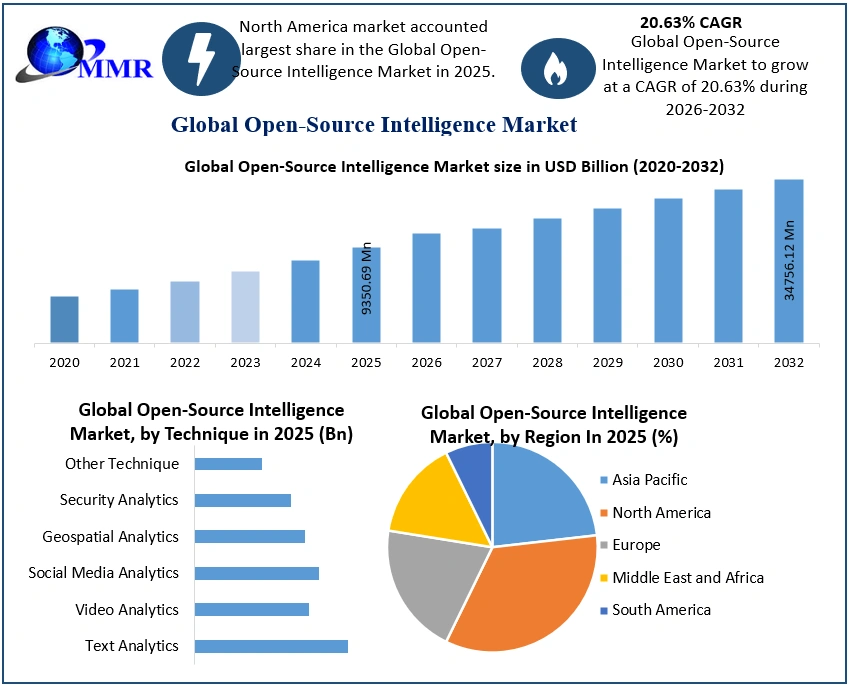
The Open-Source Intelligence (OSINT) Market is experiencing strong expansion driven by rising cybersecurity threats, increasing digital data generation, and widespread adoption of AI-based analytics. The market was valued at USD 9,350.69 million in 2025 and is projected to reach USD 34,756.12 million by 2032, growing at a robust CAGR of 20.63% (2026–2032).
OSINT refers to intelligence derived from publicly available information sources such as news, social media, websites, academic publications, and government records. It is widely used by governments, defense agencies, cybersecurity firms, and enterprises for decision-making and threat detection.
What is OSINT?
Open-source intelligence involves collecting, analyzing, and structuring publicly available data to generate actionable insights.
Key characteristics include:
- Uses publicly accessible data sources (free or subscription-based)
- Converts raw data into structured intelligence
- Supports security, business strategy, and threat monitoring
- Used by both defenders and threat actors
Major OSINT users include intelligence agencies, cybersecurity organizations, and defense institutions.
To know the most attractive segments, click here for a free sample of the report:https://www.maximizemarketresearch.com/request-sample/66653/
Market Growth Drivers
- Rising Cybersecurity Threats
Increasing cyberattacks and digital fraud have made OSINT essential for:
- Threat detection
- Risk intelligence
- Incident prevention
- Expansion of Digital Data Sources
Explosion of data from:
- Social media platforms
- Online news portals
- IoT devices
- Public databases
- Adoption of AI and Big Data Analytics
AI enhances OSINT capabilities by:
- Automating data collection
- Improving sentiment analysis
- Detecting anomalies faster
- Government and Defense Demand
OSINT is widely used for:
- National security monitoring
- Military intelligence
- Counter-terrorism operations
Leading technology providers include IBM, Palantir Technologies Inc., and Recorded Future.
Market Challenges
- Data Quality Issues
Large volumes of unverified or irrelevant data reduce accuracy and increase processing complexity.
- Cybersecurity Vulnerabilities
Open-source systems can be exploited by attackers due to:
- Delayed security patches
- Exposure of AI systems to adversarial attacks
- Privacy and Regulatory Concerns
Strict regulations such as GDPR create compliance challenges for data monitoring and behavioral analytics.
- Lack of Awareness
Many organizations still lack full understanding of OSINT capabilities and applications.
To know the most attractive segments, click here for a free sample of the report:https://www.maximizemarketresearch.com/request-sample/66653/
Key Market Trends
- Social Media Intelligence (SOCMINT)
Growing use of social platforms for:
- Sentiment tracking
- Threat detection
- Behavioral analysis
- AI-Powered OSINT Platforms
Advanced tools are enabling:
- Automated intelligence extraction
- Predictive analytics
- Real-time monitoring
- Integration with Cybersecurity Systems
OSINT is increasingly embedded into cybersecurity workflows for proactive defense.
Segment Analysis
By Technique
- Security Analytics (dominant segment)
- Text Analytics (fast-growing)
- Social Media Analytics
- Video Analytics
- Geospatial Analytics
Security analytics leads due to its strong use in detecting cyber threats across government and enterprise systems.
End-User Insights
OSINT is widely adopted across:
- Government Intelligence Agencies
- Military & Defense Organizations
- Cybersecurity Firms
- Law Enforcement Agencies
- Financial Institutions
- Private Enterprises
Defense and cybersecurity remain the largest consumers of OSINT solutions.
To know the most attractive segments, click here for a free sample of the report:https://www.maximizemarketresearch.com/request-sample/66653/
Regional Analysis
North America (Market Leader)
North America dominates the global OSINT market due to:
- High cybersecurity investments
- Strong defense infrastructure
- Advanced digital intelligence adoption
The United States leads adoption through agencies and private firms like ZeroFox, Babel Street, and Flashpoint Inc..
Europe
Strong regulatory environment drives OSINT adoption in:
- Cybersecurity compliance
- Financial crime monitoring
- Intelligence sharing frameworks
Asia Pacific
Fastest-growing region due to:
- Expanding digital economy
- Rising cyber threats
- Increasing government surveillance investments
Countries like India, China, and Japan are key contributors.
Competitive Landscape
The OSINT market is highly competitive, with vendors focusing on AI integration, real-time analytics, and cloud-based intelligence platforms.
Key players include:
- Palantir Technologies Inc.
- IBM
- Recorded Future
- ShadowDragon
- Skopenow, Inc.
- CybelAngel
Strategic Focus Areas:
- AI-driven intelligence automation
- Cloud-based OSINT platforms
- Cyber threat intelligence integration
- Real-time monitoring tools
Future Outlook (2026–2032)
The OSINT market is expected to evolve significantly with:
- Greater integration of AI and machine learning
- Expansion of real-time threat intelligence systems
- Stronger government cybersecurity investments
- Increased use in financial fraud detection
- Growth of predictive intelligence platforms
Conclusion
The Open-Source Intelligence market is becoming a critical component of global cybersecurity and intelligence infrastructure. As digital data continues to grow exponentially, OSINT will play a vital role in transforming raw information into actionable insights.
With a projected value of USD 34.75 billion by 2032, the market is set for sustained high growth, driven by AI adoption, cybersecurity demand, and expanding defense applications.

